
Before diving into mushroom dosages and strains, it is important to say that everybody is different, and every body is different. What follows is not a formula, but a way of approaching dose and journey planning with more information and greater trust in your own intuition.
Beyond the Dose: Common Factors That Shape the Experience
Before diving into dosage, let’s be clear: the amount you take is only one part of the picture.
Research on psychedelic response increasingly supports that view. A 2021 systematic review by Aday and colleagues, for example, found that baseline traits and states, including mindset, personality, and prior expectations, can meaningfully shape acute psychedelic effects.
Aday et al. (2021) — Predicting Reactions to Psychedelic Drugs: A Systematic Review
Body Weight and Dosage
Interestingly, body weight does not appear to be one of the clearest drivers of psilocybin response, despite how often people assume it must be. In a 2021 analysis of psilocybin dosing approaches, Garcia-Romeu and colleagues found no evidence that body weight affected subjective effects across a participant weight range of 108 to 250 lbs, and they argued that fixed dosing may be reasonable in many treatment contexts.
Garcia-Romeu et al. (2021) — Optimal Dosing for Psilocybin Pharmacotherapy
A later study by Holze and colleagues reinforced that point, reporting that body weight did not influence either psilocybin absorption or the response to psilocybin in healthy participants.
In plain terms, two people of similar size may respond quite differently, while two people of very different size may respond more similarly than expected. Sensitivity appears to be more personal than mechanical.
Psilocybin Mushroom Strains: Potency and Characteristics
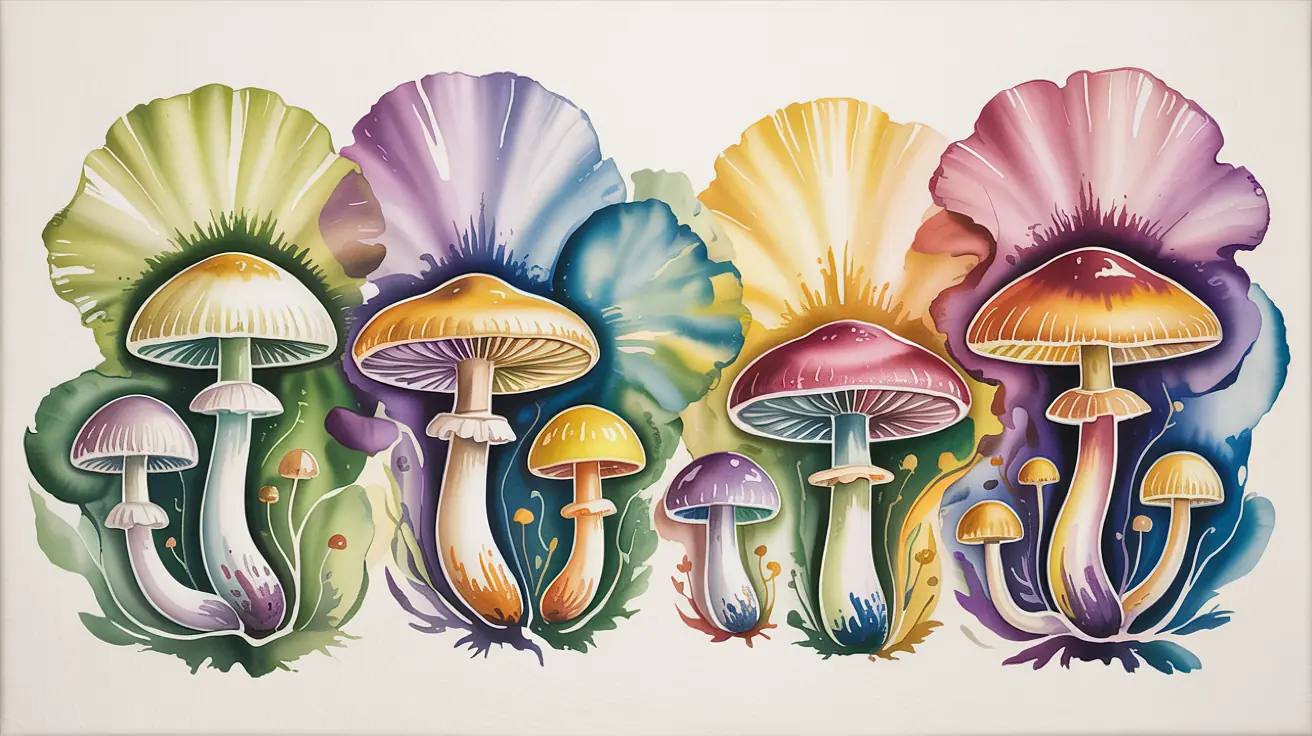
People often talk about mushroom strains as though each one comes with its own fixed personality: gentler, deeper, more visual, more euphoric, more spiritual.
While some of those patterns may reflect real differences in potency or chemical variation, much of this language is subjective and shaped by personal report. That can leave people disappointed when an experience does not match the story they were told to expect.
Common Mushroom Strains: A (Rough) Potency Guide
These are best understood as broad orientation points, not guarantees. Potency can vary meaningfully by batch, growing conditions, storage, and identification.
| Strain | Potency | How it’s often described | Practical note |
|---|---|---|---|
| B+ (B Plus) | Mild to moderate | Often described as approachable, easygoing, and relatively gentle. | A common reference point for people looking for a softer entry. |
| Golden Teacher | Mild to moderate | Often associated with a balanced, reflective, and beginner-friendly experience. | Widely treated as approachable, though the “character” is still partly anecdotal. |
| Amazonian | Moderate | Commonly described as immersive, energetic, and more visually assertive. | Better approached with some caution if you are new to non-ordinary states. |
| Albino A+ (AA+) | Moderate to moderately high | Often associated with stronger perceptual shifts and vivid visuals. | Reputation can run ahead of certainty, so it is better treated as a stronger option than a promised type of trip. |
| Natalensis | Moderately high | Often described by cultivators and users as clearer, more energetic, and somewhat stronger than many common cubensis strains. | Label carefully, since older community use of “natalensis” sometimes overlaps with newer “Ochras” naming. |
| Ochras | Moderately high to high | A newer name in circulation, often described as strong, visually vivid, and more intense than many standard cubensis strains. | Best framed cautiously because the naming is newer and public descriptions are still a mix of taxonomy and community report. |
| Penis Envy | High | Widely regarded as more potent than many other commonly available strains. | A useful reminder that strain reputation can matter, especially when translating familiar doses across strains. |
How to Think About Strain Choice
For those newer to psychedelics, I often point to Golden Teachers as a more approachable place to begin. For a deeper and more intentional therapeutic journey, P. natalensis may offer a powerful experience that some people find gentler on the body.
As experience grows, strain becomes more a matter of personal preference and response. Even so, it helps to know the strain, when possible, and to have some sense of its general potency. Three grams of B+ will likely not feel the same as three grams of Albino Penis Envy.
As a rule of thumb for those new to mushrooms, moderate strains and lower doses are generally easier places to begin than highly potent mushrooms taken too quickly or with too much confidence.
Reflections Along the Way
Subscribe for occasional updates on new writing, free guides and worksheets, events, and upcoming retreats.
Preparing for the Journey
Keep in mind that dosing is just one factor that can shape an overall experience. Some mind and body preparation can influence an experience just as much as quantity does.
What Good Preparation Can Look Like
What does good preparation honestly look like? Not perfection. For me, it begins with listening to myself and my body before an experience. I reflect on readiness, tidy the space I’ll be journeying in, reduce avoidable stressors where I can, and if something feels clearly off, I consider postponing.
I do not wait to feel perfect. Many people come to psychedelics because something in them feels stuck, unresolved, or in need of attention. But preparation still asks for honesty: whatever you are carrying in waking life may be intensified once the experience begins.
Setting an Intention
Which also helps explain why setting an intention can matter even before a lighter, more recreational journey. But what is an intention, really? For me, it is noticing where life has slipped out of balance. I ask what I most want to bring into my life right now and then I listen for what feels absent or neglected.
If I find myself wanting to repair a fissure between myself and a long-absent friend, or to care for my health with more seriousness, then I am already learning something. Some relationship in my life, whether to another person, to my body, or to a wider community, has gone out of sync.
Listening for What the Body Already Knows
We often feel that before we can explain it; the body usually knows first. If we are willing to sit quietly enough, thought begins to gather around that feeling. That is one reason I often recommend even a small meditation practice before a journey.
What an Intention Is, and Is Not
What an intention is not is a goal. It is not self-pressure dressed up as insight. It is not “lose ten pounds” or “be nicer.” It is naming an imbalance and asking, with openness, for understanding. “I want to bring more community into my life and understand why some part of me has grown suspicious of the very people who have supported me.” An intention does not control the experience. It simply gives the heart and mind a place to look when the journey begins. If you’d like help with that process, I’ve created a free downloadable guide to help with intention setting.
A More Grounded Way to Think About Dose
It can be tempting to ask, “What is the right dose?” But often the better question is, “What kind of experience am I actually prepared for?”
What matters most is not chasing an ideal number, but choosing with honesty, humility, and respect for uncertainty. Dose matters, but so do readiness, support, and the life you are bringing into the experience. In that sense, the better question is often not simply how much to take, but what kind of journey you are truly prepared to enter.